
Election Results
Last Updated: November 4th, 2020 at 2:45pm

Too Close to Call

Votes are still being counted in a historic presidential election.

Millions of ballots are still being counted in a historic presidential election

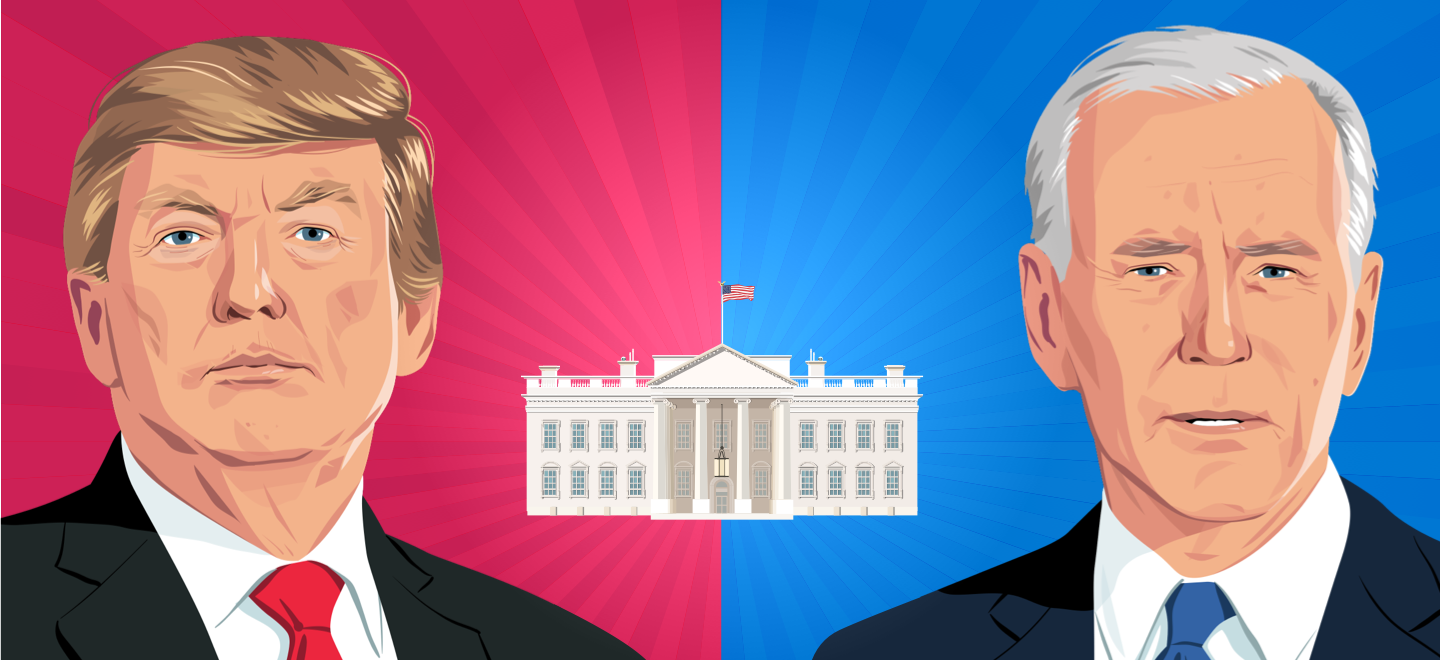
Election Day has come and gone, but the nation is still waiting to find out who will be elected president: Donald Trump or Joe Biden. Early Wednesday morning, President Trump declared himself the winner of a very close race. But the votes are still being counted in several key states, and an official winner has not yet been announced.

Each candidate represents one of the two main political parties in the U.S. President Trump is the Republican candidate. He is hoping to win a second four-year term in the White House. Biden is the Democratic candidate.

Americans nationwide are still eagerly awaiting the results of Tuesday’s presidential election, wondering who will take the oath of office on January 20: President Donald Trump, a Republican, or former Vice President Joe Biden, a Democrat.

By 4:45 p.m. Wednesday on the East Coast, Biden and his vice presidential running mate, U.S. Senator Kamala Harris, had secured 253 electoral votes. Trump and his running mate, Vice President Mike Pence, had secured 214 electoral votes. A candidate needs at least 270 electoral votes out of 538 to win the presidency.

Meanwhile, in the congressional races, Democrats are on track to keep a majority of seats in the U.S. House of Representatives. But experts say it could be a while before we know which party will have a majority in the U.S. Senate.

The final outcomes in several states, including the swing states of Georgia, Nevada, and Pennsylvania, remain unclear. Tens of millions of Americans nationwide voted by mail, many more than in any previous election. Processing mail-in ballots can be time-consuming, and many are still being counted.

Election experts say it could be days—or even weeks—before a winner is declared in many races, including for the presidency.

“There are certain states where the vote counts take a long time,” says Kyle Kondik of the University of Virginia Center for Politics. “It’s not a . . . sign that anything is wrong.”

How America Votes

A Unique Election

By early Wednesday morning, more than 130 million votes had been counted nationwide. Biden was leading in the popular vote. That means more Americans have voted for Biden than Trump based on the ballots counted so far.

But in the U.S., voters don’t directly elect the president. Instead, we use a system called the Electoral College. The candidate who receives the most popular votes in a state wins that state’s electoral votes. Whichever candidate gets 270 or more electoral votes will be president. (Click here to learn more about the Electoral College.)

So far, Biden has an edge in the Electoral College. But the election will be decided in states that are still too close to call for either candidate. Those states include Arizona, Pennsylvania, and Nevada. (See the latest state-by-state results on the map at the bottom of this page.)

This presidential election has already been unlike any other in U.S. history. Never before have Americans had to cast their ballots during a pandemic, fearing that going to the polls might expose them to a potentially deadly disease.

Earlier this year, many states changed their voting rules and procedures to keep voters safe and to allow more people to cast their ballots by mail. In addition, tens of millions of Americans cast ballots in person during early voting periods before Election Day to avoid crowded polling places on November 3.

Still, this isn’t the first presidential election in which the results weren’t immediately clear. The most recent example was in the year 2000, when Republican George W. Bush and Democrat Al Gore competed for the presidency. The results of that election remained unclear for more than a month because millions of ballots in Florida, a key swing state, needed to be recounted. On December 12, 2000, the U.S. Supreme Court stopped the recounts, effectively declaring that Bush had won Florida—and the presidency.

A Historic Election

Major Challenges Ahead

No matter who wins, this presidential election has already been unlike any other in U.S. history. For the first time, Americans have had to cast their ballots for president during a pandemic. Many people worried about the spread of Covid-19 at crowded polling places on Election Day. To try to keep voters safe, many states gave them additional ways to cast their votes this year.

For example, most states either expanded early voting or allowed it for the first time. People in those places could cast their votes at polling places on specific dates before Election Day.

Also, many states allowed many more people to vote by mail this year. By the time Election Day rolled around, more than 100 million people had already cast their ballots. That set a record for early voting.

Whichever candidate wins this election will face enormous challenges. Tackling the coronavirus pandemic, which has killed more than 232,000 people in the United States and affected nearly all aspects of daily life over the past eight months, is expected to be a top priority. 

Indeed, in pre-election surveys of voters, the government’s pandemic response was one of the most important issues. Another was the U.S. economy, which has been devastated by the pandemic. Millions of people have lost their jobs, and more than 100,000 businesses have permanently closed. Other key issues for voters included health care, immigration, addressing racial injustice, and protecting the environment. 

With so much critical work to do, Americans are eager to have the outcome of the election settled. But experts urge everyone to stay calm as the votes are counted. 

“This isn’t the first time in our history that we don’t have results right away,” says Ray La Raja, a political science professor at the University of Massachusetts, Amherst. “Americans are going to have to be patient, and we need leaders in both parties to remind people to stay calm.” 

The Counting Continues

Vocabulary

In past presidential elections, news organizations were often able to name the winner on election night. But the surge in mail-in votes means election officials need much longer to tally the results this year. Election experts say it could be several days before a winner is declared.

“Americans are going to have to be patient,” says Ray La Raja. He is an expert on politics and a professor at the University of Massachusetts, Amherst. “And we need leaders in both parties to remind people to stay calm.”

Republican (n) a person who belongs to or supports the Republican Party, one of the two main political parties in the United States. Republicans tend to favor tradition and stability over social and political reforms.

Democrat (n) a person who belongs to or supports the Democratic Party, one of the two main political parties in the United States. Democrats tend to support social and political reforms.

House of Representatives (n) one of the two chambers of the U.S. Congress. Its 435 members serve two-year terms.

Senate (n) one of the two chambers of the U.S. Congress. Its 100 members serve six-year terms.

swing states (n) states with many voters who aren’t loyal to a particular political party. Voters in swing states often determine who wins presidential elections.

pandemic (n) an outbreak of a disease that spreads quickly and affects many people in different areas

U.S. Supreme Court (n) the highest court of law in the United States

economy (n) a system for making, buying, selling, and distributing products and services within a country, a region, or an industry

political science (n) the study of governments and how they work

Vocabulary


candidate noun. a person who is running for an elected position

political parties noun, plural. groups of citizens with similar ideas on how the country should be run

term noun. the length of time a public official serves in office. The term of the U.S. president is four years.

popular vote noun. the voting done by regular citizens, rather than electors. In a presidential election, the popular vote includes tens of millions of votes.

pandemic noun. an outbreak of a disease that spreads quickly and affects many people around the world

polling places noun, plural. places where people go to vote (also known as polls)

politics noun. the activities and discussions involved in governing a country, state, or city


Electoral Map

Electoral Map

Text-to-Speech