

When Cookbook-Style Science Labs Don’t Work Anymore
How school districts can leverage ScienceFlix® to individualize instruction and bring science to life so students can engage with hands-on experiences, learn at their own reading levels, and meet Next Generation Science Standards.
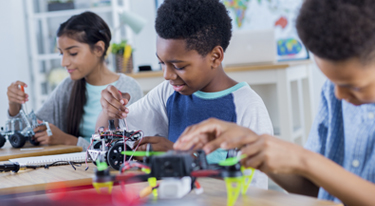
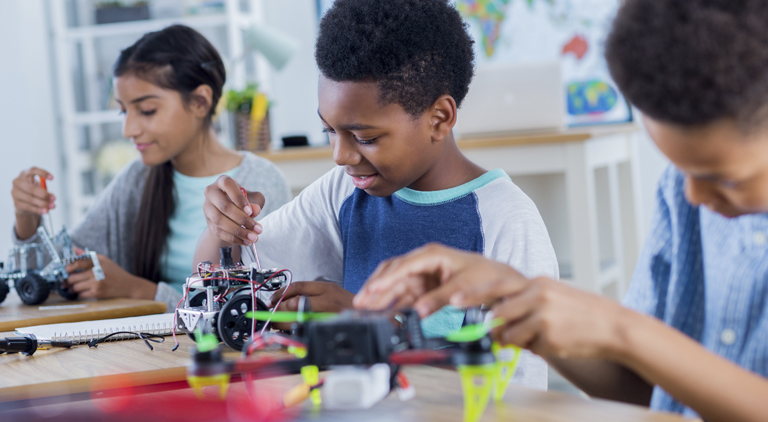
Students don’t learn science by reading and regurgitating answers to standardized questions, nor do they grasp scientific concepts by memorizing content fed to them via textbooks. When they don’t have hands-on experiences and opportunities to apply their knowledge, learning becomes superficial and most pupils forget about science as soon as the class is over.
These challenges present high hurdles for teachers and curriculum directors. For students to really “get it,” science must be taught in a hands-on, engaging way that helps pupils understand complex topics, see concepts in action, and better comprehend the world around them.
The Next Generation Science Standards (NGSS), developed by a team of 26 states, provide leadership on writing science curriculum that is rich in content and practice. The NGSS challenge K–12 schools to think beyond traditional methods to provide all students with internationally benchmarked science standards.
According to NGSS, “Science—and therefore science education—is central to the lives of all Americans, preparing them to be informed citizens in a democracy and knowledgeable consumers.
If the nation is to compete and lead in the global economy, and if American students are to be able to pursue expanding employment opportunities in science-related fields, all students must have a solid K–12 science education that prepares them for college and careers.”
Previously, states used the National Science Education Standards from the National Research Council (NRC) and Benchmarks for Science Literacy from the American Association for the Advancement of Science (AAAS) to guide the development of their state science standards. These standards, developed over 15 years ago, don’t factor in the major advances that have taken place in the world of science and in the educational world’s understanding of how students learn science effectively.
More Applications and Investigations
Harry Rosvally Jr., K–12 STEM curriculum administrator at Danbury (CT) Public Schools, says ScienceFlix helps students experience the kind of the hands-on, minds-on engagement that they need to grasp the often complex subject matter. “NGSS is trying to take science and make it less ‘cookbook’ and procedural, and more application-based and investigative.”
Rosvally, who oversees math and science curriculum for the district, consulted with Scholastic to develop the ScienceFlix labs. He says creating more hands-on, inquiry-based lessons are particularly difficult at the middle-school level, where some teachers hold K–6 certifications and have only taken one or two science classes themselves. “They need more background, and they also need ideas for simple and straightforward investigations that students can understand,” he says. “ScienceFlix helps with this, and also enhances student engagement by starting them off with videos and Lexile- specific reading assignments.”
For example, the platform’s “virtual dissections” allow students to dissect specimens without the need for actual frogs or worms (and without the mess). “Some students are nauseated by dissections and some parents have religious beliefs that hold their kids back from doing them,” says Rosvally. “Suddenly we have access to an easier dissection method and more students interested in science because of it.”
The latter is particularly important because NGSS is not only focused on in-school learning, but also on college and career readiness. “It’s a safe, clean way to get students hooked on potential STEM careers as early as middle school,” says Rosvally. Each ScienceFlix unit includes a careers feature that offers a full discussion of careers in the fields covered by the unit and a guide to the courses and training a student would need to pursue the career.
Emphasizing Evidence-Based Learning
Joseph M. Castagno, senior director of digital products for Scholastic Library Publishing, says there were no other hands-on, NGSS-aligned science education platforms on the market when ScienceFlix was being developed. In particular, no science platforms were focused on reading-level functionalities that allow students to view at their respective Lexile levels.
“Nothing even came close to doing that, and it still doesn’t,” says Castagno, who hears stories daily from teachers about students who have phobias about learning science, or who simply shut down because they don’t think they can do it. After implementing ScienceFlix, he says the same educators rave about the platform and how it helps them reach students who wouldn’t otherwise be interested or engaged in science.
With an emphasis on evidence-based learning, the ScienceFlix platform aligns with the STEM component of NGSS and offers varying text complexities (i.e., every article is available at three different reading levels). ScienceFlix also includes visual material and text that is constructed so that the student completes each unit with a clear understanding of the topic’s main ideas (instead of just minor details). Through ScienceFlix’s “Technology and Engineering” topic strand, for example, students can focus on applications of science—an area that’s often overlooked.
Castagno says the platform’s astronomy and space science units have “extremely high usage rates.” Although neither subject features prominently in NGSS, the platform is helping students to broaden their knowledge and follow their intellectual curiosity. ” Castagno says ScienceFlix’s makerspace unit proved popular recently for a librarian who was “on the fence” about adopting the platform. When teachers assigned a paper on the makerspace phenomenon, ScienceFlix was the only resource where the librarian could find resources about the history and future of makerspaces, as well as examples, in one place, and all tied together with an educational video. “She decided to implement ScienceFlix based on that single success,” says Castagno.
Getting Students Onboard with STEM
Rosvally sees good potential for ScienceFlix in K–12 schools, where teachers and curriculum directors need new, innovative, and engaging ways to teach NGSS- aligned content. And because ScienceFlix offers a differentiated approach that factors in each student’s reading level, the platform breaks out of the “cookbook mold” and allows pupils to experience and absorb science knowledge at their own pace.
“If we can get them engaged and hooked, and give them the chance to do something authentic,” says Rosvally, “we can get more kids succeeding in science and interested in STEM careers.”
“If we can … give them the chance to do something authentic, we can get more kids succeeding in science and interested in STEM careers.” —Harry Rosvally Jr. K–12 STEM curriculum administrator, Danbury Public Schools
Offering more than 70 complete units of study with over 9,500 science-related assets in a variety of media, ScienceFlix® provides students with a better understanding of science concepts and ideas through hands-on projects, videos, multiple text types, interactive features and more.
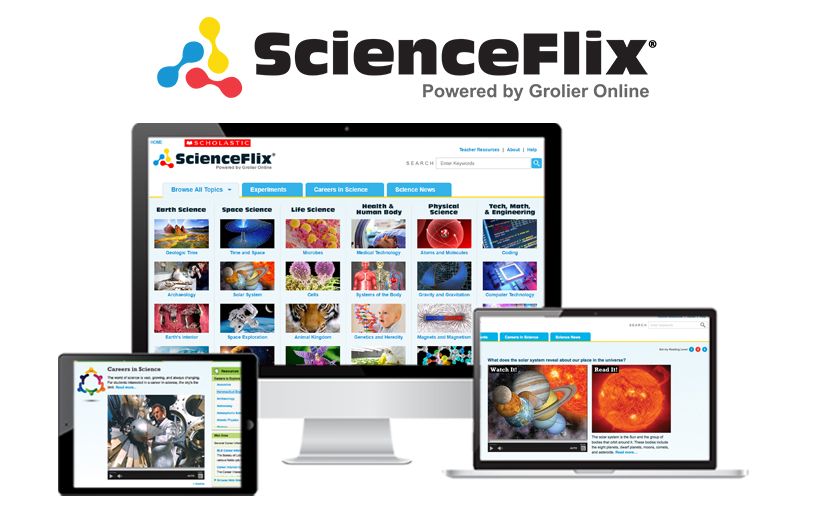
Each content unit provides a broader view of the scientific world and includes:
articles in 3 different reading levels | Spanish articles | related websites | experiments | science careers | science news