


Strengthen ELA Learning Across Content Areas
By aligning middle-school science content with engaging texts at flexible reading levels, ELA instructors use ScienceFlix® to help students take ownership of their learning.



For Malinda Murphy, finding engaging texts that are geared to individual students’ reading levels is an ongoing challenge. A Secondary ELA Curriculum Specialist at Lincoln (NE) Public Schools, Murphy says below-level readers struggle not only with the content, but also with text that’s too complex. “Most ELA students don’t necessarily need help with the decoding,” says Murphy, “but their vocabulary knowledge tends to be low.”
To help fill some of those gaps, Murphy set out to find a solution that their middle-school reading teachers could use to align content with the actual reading level. Previously, most platforms that offered texts at different Lexile levels focused on literature and had very little nonfiction. “I wanted a solution that would provide a wide array of topics within our seventh- and eighth-grade science curriculum,” says Murphy, “that we could then support in our reading classes.”
Aligning Science and Reading
Intent on finding a product that also featured texts at different reading levels, Murphy spent a lot of time looking around the marketplace and reviewing the options. “If there’s something on the market that I didn’t see, I’d be surprised,” says Murphy. “I looked for a very long time to try to find the right solution.” After speaking with a Scholastic representative about ScienceFlix, Murphy— who had previously used FreedomFlix and TrueFlix— decided the platform had “the most applicability to what we were doing with our reading classes.”
Using curriculum-driven content that’s integrated with interactive features and intuitive navigation, ScienceFlix reinforces a solid understanding of science concepts and ideas through hands-on projects, videos, and multiple text types. Through its interactive approach, the software helps pupils build content knowledge, develop inquiry- based learning skills, and navigate complex texts.
During a test run of the program, Murphy says she immediately loved the platform’s graphics and the way it breaks down technical topics into short, two-minute snippets. “The background information is supported by very appealing visuals that make the text accessible for a broad range of readers,” she says.
The program also helps support Lincoln Public Schools’ commitment to teaching digital citizenship by showing students—after every passage—how to properly cite in Chicago, APA, and MLA style. Murphy says students can also get firsthand knowledge of what it’s actually like to work in a technical field.
“We’ve been pushing very hard in our district to increase girls’ interest in the sciences,” says Murphy. She’s seeing increased usage of the platform in the district’s middle-school science classes, which are in the early stages of integrating the Next Generation Science Standards (NGSS), that ScienceFlix supports. She expects usage to increase gradually as more teachers discover the platform’s value. “Any time students need to do extra reading or have a complicated science topic explained in a different way and at their reading level,” says Murphy, “our science teachers will be able to meet that need by giving pupils access to ScienceFlix.”
Covering Every Single Topic
In Lincoln Public Schools’ ELA reading classes, teachers are using ScienceFlix to select articles that align with the current seventh- and eighth- grade science curriculum. Those articles are then used during guided reading groups in the classroom and for independent literacy work. Teachers assign a ScienceFlix article, for example, along with the related task (e.g., an annotation, short answer, main idea, key details, or inferencing activity).
Because the learning platform is available 24/7 online, Murphy says a high percentage of students are using it at home to guide their own learning. “We can see that students are reading the articles and doing the quizzes on their own,” she says. “That’s kind of exciting.”
Murphy says the solution’s user-friendly website covers “every single topic” offered in middle-school science classes. “Finding the appropriate article for any given topic is easy,” she explains. “Our teachers really like that capability.”
Giving Students Ownership of Their Learning
ScienceFlix also gives ELA students more ownership of their learning by allowing them to see the related topics and subjects that they might like to explore independently. An eighth-grade ELA student who is interested in ecology, for example, may notice the various other articles available on the topic and ask, “Can we do this one for guided reading tomorrow?”
“It’s great because it’s not just the teachers controlling what the students are able to see and explore,” says Murphy. “The students themselves can also make those suggestions and decisions about their own learning.”
Although Lincoln Public Schools has not yet formally quantified the effectiveness of using ScienceFlix in ELA, Murphy says the platform is very widely used across the district. “The teachers and students both love it,” she says, “and there’s seriously nothing else out there that can fit this need that we have.”
“We’ve been pushing very hard in our district to increase girls’ interest in the sciences.” —Malinda Murphy ELA curriculum specialist, Lincoln Public Schools
Offering more than 70 complete units of study with over 9,500 science-related assets in a variety of media, ScienceFlix® provides students with a better understanding of science concepts and ideas through hands-on projects, videos, multiple text types, interactive features and more.
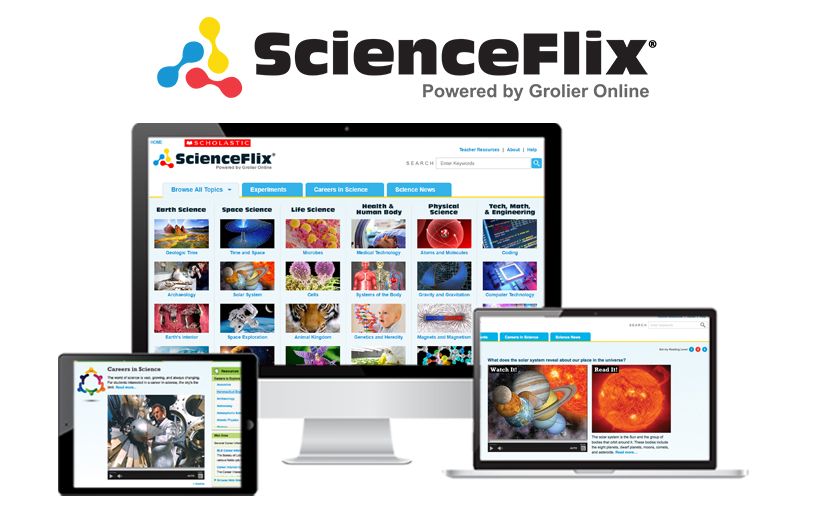
Each content unit provides a broader view of the scientific world and includes:
articles in 3 different reading levels | Spanish articles | related websites | experiments | science careers | science news