

Louisiana Public Libraries Boost Students’ STEM Knowledge
How two different library systems are using ScienceFlix® to transform the way students access science topics, acquire scientific knowledge, and build a lasting interest in science, technology, and engineering.



With a large number of its patrons participating in science fairs at the school, district, and state levels, Rapides Parish Library in Alexandria, Louisiana, needed a better way to get science content into students’ hands. Relying mainly on traditional, hardcover texts that were only circulated to a limited number of learners, the library could only “check out so many books at a time,” says Tammy DiBartolo, youth services/outreach coordinator.
The challenges became particularly acute whenever area schools kicked off specific projects. For example, because it’s situated in an area where wetlands are prevalent, Rapides Parish Library gets hit hard when science teachers send students out to find out everything they can about these water- covered marshes and swamps.
“We order wetlands books for all of our branches, but every one of those texts is gone as soon as those projects kick into gear,” says DiBartolo. “We just can’t keep enough books on the shelves to meet the schools’ needs.”
The library was already using other Scholastic products, and DiBartolo says the staff liked the way ScienceFlix offered grade-level information, project ideas, and instructions. “We always attempt to supplement schools (and their libraries) with materials,” she says. “We also have a large homeschool population here that uses the library to help supplement their curriculum. So, ScienceFlix is also very helpful in that respect.”
Curriculum-Driven Science Content for All
In 2016, DiBartolo learned about ScienceFlix from a Scholastic representative. Using curriculum-driven content that’s integrated with interactive features and intuitive navigation, ScienceFlix provides a solid understanding of science concepts and ideas through hands-on projects, videos, and multiple text types.
The interactive software helps pupils build content knowledge, develop inquiry-based learning skills, and navigate complex texts.
“When ScienceFlix was presented to us, it looked like a good match for what we were doing,” says DiBartolo. In the early stages of purchasing 3D printers for its makerspace the library has since used ScienceFlix to support the coding classes that it started offering in late 2016.
“We recently held a STEM camp for students aged 9 to 15, with the kids coming in at different times to talk about the makerspaces and about how to advance their education and explore careers in science,” says DiBartolo. “We used ScienceFlix to enhance that experience and to facilitate the makerspace (i.e., by providing instructions and content on technical topics).”
Rapides Parish Library also uses the software to support school assignments and the various science fairs that the library attends and judges every year. In most cases, students use their own smartphones and tablets to access ScienceFlix and interact with its content. DiBartolo says once the digital natives are logged in and rolling, “most of them can take it from there; they know what to do.”
Stepping Up an Emphasis on Science
Prior to implementing ScienceFlix, Ascension Public Library in Baton Rouge relied on books— including a small collection of Spanish texts—to disseminate knowledge to students. Being limited to these texts wasn’t conducive to exploring technical subjects like science, which students tend to learn best in an interactive, visual, and/or hands-on setting.
“If we were working with a science-related program, we basically just put the related books on display in the library,” recalls Larie Myers, associate library director. “We’ve definitely stepped up our emphasis on science with the schools since implementing the software.”
They were already using BookFlix and Myers says the library uses ScienceFlix to help students build content knowledge in STEM topics and comprehension in a wide range of text types.
ScienceFlix also gives pupils practice with hands- on, scientific learning in ways that print books cannot accommodate.
Engaging English Language Learners
Located in the fastest growing parish in Louisiana, Ascension Parish Library also faces some unique literacy hurdles. “We have more than 450 students in our school system who don’t speak English at all,” says Myers. Being able to read and write in English is one thing, but comprehending technical subject matter when English isn’t your first language is even more difficult.
Twice a year, the library hosts a “literacy night” and welcomes students, parents, and members of the community to come and visit its facility. During the event, the Library also introduces students and their parents to ScienceFlix, which it implemented about three years ago.
Myers says the software has helped bridge the language gap and accommodates students who previously lacked the best possible learning resources. “When I was at a parents’ night event last year, there were a lot of Hispanic parents who didn’t speak much English,” says one of the library’s youth services directors. “They got really excited when I showed them how they could read an article in ScienceFlix in both Spanish and English, and some made comments about how good it would be to be able to help their kids with homework.”
Going Above and Beyond
Similar to Rapides Parish Library, Ascension Public Library also uses the platform to support the various science fairs that it judges and supports throughout the year. “We love the product, and we get good user statistics from it,” says Myers.
“Five of our public schools were completely flooded in August of 2017; school libraries, textbooks, and classroom book sets were lost,” Myers says, noting that children and faculty members were moved to temporary buildings for the entire school year.
“With Scholastic’s permission, all of the Flix products were made available to these schools through our subscription,” says Myers. “This filled the huge need for resources, as well as the Common Core paired requirement, for our parish.”
With ScienceFlix, Rapides Parish Library and Ascension Public Library are helping to ensure that all students have equitable access to STEM content at multiple reading levels to improve learning outcomes. Each core idea is thoroughly covered through practice, exploring essential questions, investigating, analyzing data, and computing and evaluating. Crosscutting concepts are repeatedly emphasized in ScienceFlix to provide students with a broader view of the scientific world and an understanding of how interrelating knowledge can be applied across all science disciplines.
“We love the product, and we get good user statistics from it.” —Larie Myers, associate library director, Ascension Public Library
Offering more than 70 complete units of study with over 9,500 science-related assets in a variety of media, ScienceFlix® provides students with a better understanding of science concepts and ideas through hands-on projects, videos, multiple text types, interactive features and more.
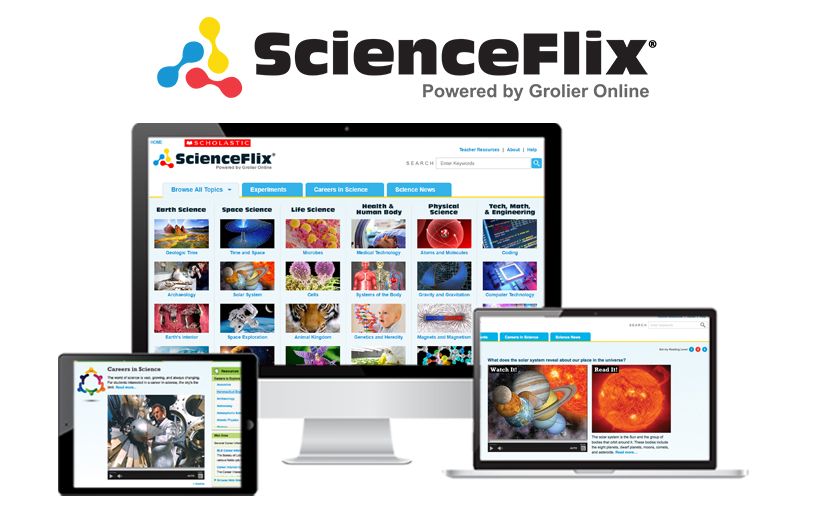
Each content unit provides a broader view of the scientific world and includes:
articles in 3 different reading levels | Spanish articles | related websites | experiments | science careers | science news