

Improving Student Knowledge and Engagement Levels With ScienceFlix
How ScienceFlix changes how students acquire scientific knowledge and build STEM proficiency.
Science, technology, engineering, and mathematics (STEM) education has emerged as one of the most sought-after curriculum designs for integrating these technical topics into K–12 education. It first became popular as a means of serving the needs of mathematically gifted students, providing opportunities both to accelerate learning and to increase the rigor and depth of learning. This combination has enabled motivated students to advance into special classes, including college classes for which they receive college credit while still in high school (Kristy M. Meyrick, "How STEM Education Improves Student Leaning").
Fast-forward to 2018, and the K–12 focus on science comprehension and STEM-related topics has grown significantly. Employers’ needs for a 21st-century workforce, the past administration’s call for the expansion of STEM education to all students, and the introduction of the Next Generation Science Standards (NGSS), are all pushing districts to reexamine the way their pupils acquire scientific knowledge and build STEM proficiency.
“STEM education is important because the world economy is changing and having technical skills and knowledge is more important than ever for students,” says Darren Sechrist, Scholastic’s senior executive editor. “Both at the middle- and high-school levels, students really need to be able to build knowledge that they can use in college programs and/or in the workforce.”
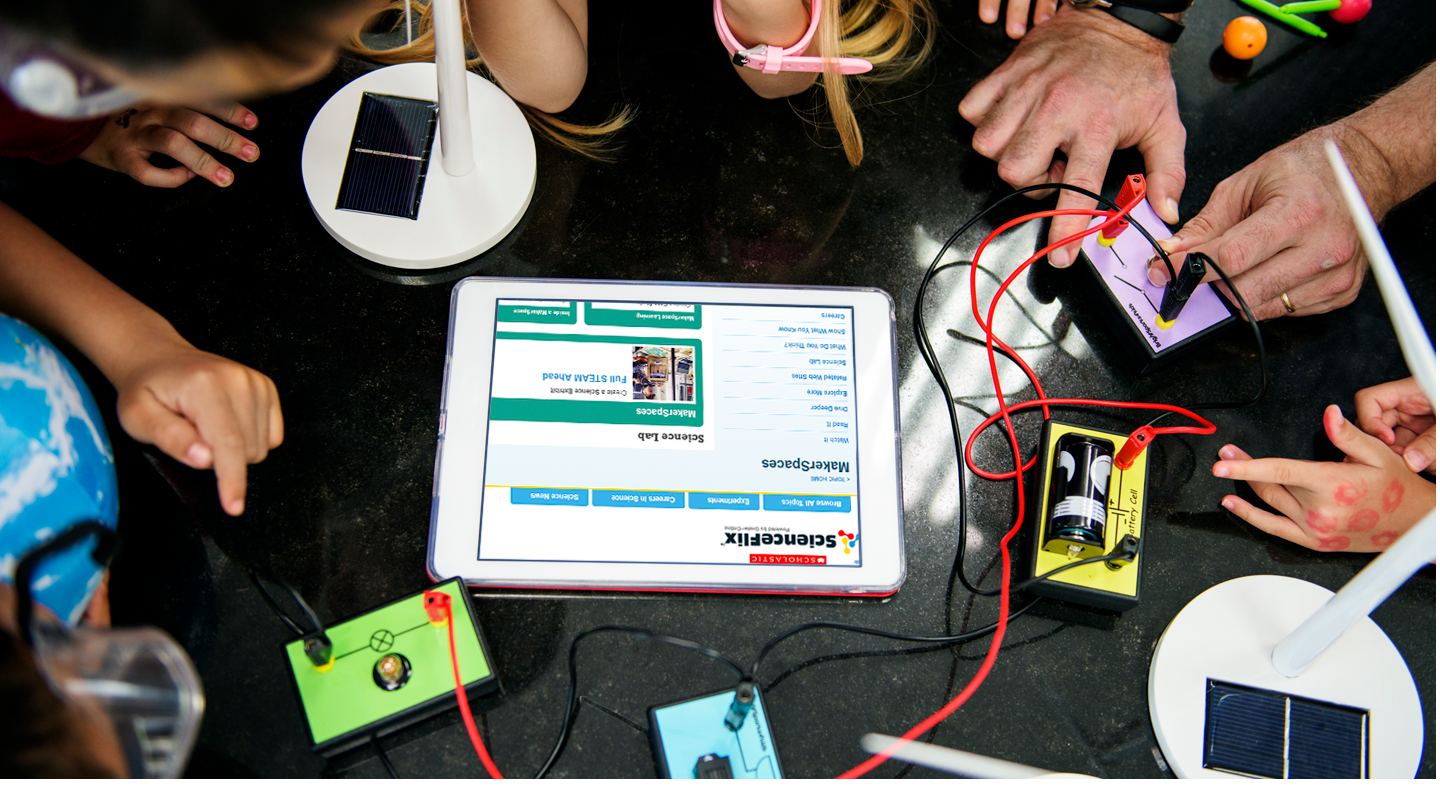
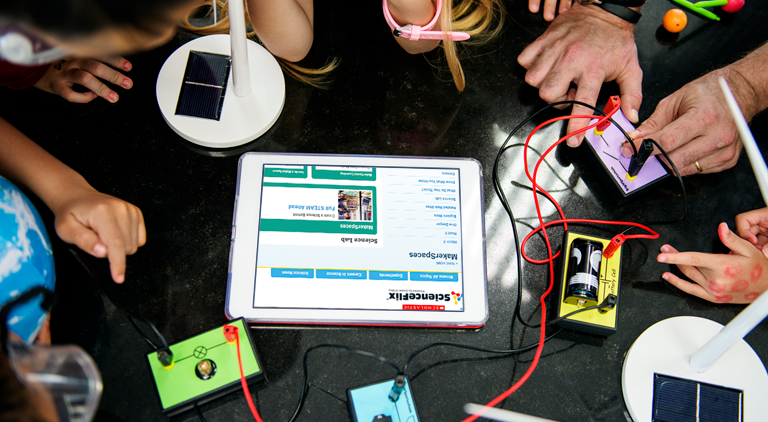
That’s where programs like ScienceFlix can make a difference. Using curriculum-driven content that’s integrated with interactive features and intuitive navigation, the platform helps students build a solid understanding of science concepts and ideas through hands-on projects, videos, and multiple text types. “ScienceFlix brings kids to STEM who might not otherwise consider such a career,” says Sechrist, “or who may not even be interested in STEM-related topics until they’re actually exposed to them.”
Fostering Innovation, Driving Creativity
According to the U.S. Department of Commerce, STEM occupations have grown 17 percent between 2008 and 2018, while other occupations are growing at 9.8 percent. Those with STEM degrees have higher incomes, even in non-STEM careers. Science, technology, engineering, and mathematics workers play a key role in the sustained growth and stability of the U.S. economy, and they’re a critical component of helping the U.S. win in the future, according to Engineering for Kids.
The benefits and rewards don’t end there. STEM education also creates critical thinkers, increases science literacy, and helps cultivate the next generation of innovators. Innovation leads to new products and processes that sustain our economy.
And while this innovation and science literacy depend on a solid knowledge base in the STEM areas—and with most future jobs requiring at least a basic understanding of math and science—U.S. students’ scores in these subject areas lag behind those of students in other developing countries (Engineering For Kids). The National Science Foundation (NSF) says that the average score for eighth graders in the U.S. on the Trends in International Mathematics and Sciences Study (TIMSS) math assessment was below the average scores of six other countries/ jurisdictions, the same as the average score in seven other countries, and higher than the average score in 28 other countries.
The average scores of students in the Republic of Korea, Singapore, and Taipei (the top three), on the other hand, were at least 100 points higher than the average score of eighth-grade students in the U.S. (NSFF)
“As technology continues to advance and become an even bigger part of our lives, even students who aren’t going to become engineers or scientists need a good base of scientific knowledge and STEM skills,” Sechrist points out. “It’s reached the point where STEM is important for everything you do—be it your private or your professional life.”
By pulling students into STEM- related topics in a fun and interesting way that “doesn’t quite seem like learning,” Sechrist says ScienceFlix helps to break down the traditional barriers that go up when a young student is introduced to technical material.
Through its interactive approach, for example, the software helps pupils build content knowledge, develop inquiry-based learning skills, and navigate complex texts. This, in turn, helps them build content knowledge in technical subject areas, comprehend a wide range of text types, and gain “real-world” practice with hands-on, scientific learning in ways that print books cannot accommodate.
Even better, ScienceFlix helps to make learning fun—an experience that most people don’t necessarily associate with science-related topics. “The software is so engaging, and it pulls students into technical topics in a very fun and interesting manner,” says Sechrist. “In many cases, the experience doesn’t even feel like ‘learning’ until the student is already deep into it.”
Inquiry-Based Science
Through its comprehensive approach to helping students build scientific knowledge, ScienceFlix starts each module by presenting students with an inquiry question that gets pupils thinking about the learning that lies ahead. “This is the foundation of our scientific approach to learning, in that it encourages students to ponder the question and try to answer it,” says Sechrist. “Our model is built around that, and all topics are curriculum-connected and standards-aligned.”
Once inside of the lesson, students connect with the scientific knowledge through various types of media— including video, text, slide shows, and timelines. This variety helps to bring the material to a wide range of learners in a comprehensible way—those who are more apt to be visual learners, for example, as well as those who best absorb knowledge by doing hands-on experiments. Through these interactions, students develop inquiry- based learning skills, navigate increasingly complex text, identify and articulate point of view, and get involved with hands-on scientific learning. Using leveled text (for three different levels), the program delivers the same information to all students, regardless of their individual reading levels. “This breaks down yet another barrier to pupils’ ability to acquire scientific knowledge,” Sechrist says.
Delivering Learning Where It Counts
As the focus on STEM continues to gain momentum, and as more employers require technical skills for even entry-level jobs, the nation’s K–12 districts will continue to turn to technology to help them meet these mandates while also aligning with the NGSS’s “learn by doing” teaching principles.
The key for schools seeking a solution that helps them achieve these goals, Sechrist says, is to find a comprehensive platform that allows teachers to reach an entire class with compelling content with which students actually want to interact and engage. “Find a way for students to engage with the content in a manner that suits them individually,” says Sechrist, “and at a level where they can truly learn.”
Offering more than 70 complete units of study with over 9,500 science-related assets in a variety of media, ScienceFlix® provides students with a better understanding of science concepts and ideas through hands-on projects, videos, multiple text types, interactive features and more.
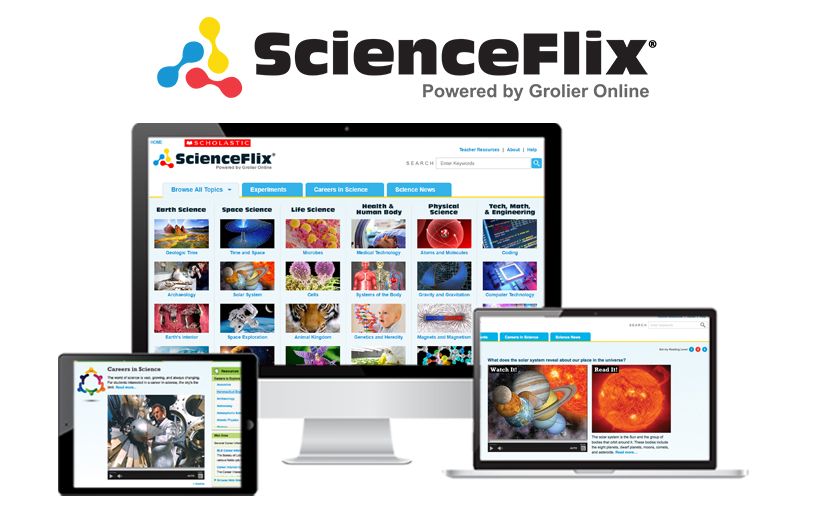
Each content unit provides a broader view of the scientific world and includes:
articles in 3 different reading levels | Spanish articles | related websites | experiments | science careers | science news