


4 Ways ScienceFlix Reinforces NGSS' Crosscutting Concepts in Science
How ScienceFlix supports the crosscutting concepts of the Next Generation Science Standards to provide students with a broader view of the scientific world.


The framework of the Next Generation Science Standards (NGSS) emphasizes that scientific concepts must be made explicit for students “because they provide an organizational schema for interrelating knowledge from various science fields into a coherent and scientifically based view of the world,” according to the National Science Teachers Association (NSTA). With applications across all scientific domains, crosscutting concepts link all of the different domains and include patterns; cause and effect; scale, proportion, and quantity; systems and system models; energy and matter; structure and function; and stability and change.
When students encounter new phenomena, whether in a science lab, field trip, or on their own, they need mental tools to help engage in and come to understand the phenomena from a scientific point of view,” the NGSS’ Framework states. “Familiarity with crosscutting concepts can provide that perspective.”
For example, when approaching a complex phenomenon (say, a natural phenomenon or a machine), it makes sense to start by observing and characterizing the phenomenon in terms of patterns.
A next step might be to simplify the phenomenon by thinking of it as a system and then modeling its components and how they interact. Then, in some cases, students may study how energy and matter flow through the system, or how structure affects function (or malfunction).
Infusing Science into the Classroom
To support these crosscutting concepts and provide students with a broader view of the scientific world, ScienceFlix™ uses curriculum-driven content that’s integrated with interactive features and intuitive navigation. By helping students gain a solid understanding of science concepts and ideas through hands-on projects, videos, and multiple text types, ScienceFlix™ pulls students into STEM-related topics in a fun and interesting way that breaks down the traditional barriers that go up when a young student is introduced to technical material.
“It’s about getting students very hands-on and giving them an understanding of how science applies to the rest of their lives,” says Joseph M. Castagno, Scholastic’s senior director of digital products. Here are four ways ScienceFlix™ helps districts achieve this goal while reinforcing the NGSS’ focus on crosscutting concepts:
1. Engaging students in multimedia content.
The science textbooks of previous years could not provide the kinds of interactive content that would engage students in technical topics, but modern-day multimedia content does a much better job. “ScienceFlix™ gets in there and hooks the student with texts, graphics, videos, charts, and experiments,” says Castagno, “all of which come together to support NGSS’ crosscutting concepts.” Through its interactive approach, for example, the software helps pupils build content knowledge, develop inquiry-based learning skills, and navigate complex texts. These skills, in turn, help them build content knowledge in technical subject areas, comprehend a wide range of text types, and gain “real- world” practice with hands- on, scientific learning.
2. Supporting NGSS’ “learn by doing” principle.
When the teaching of content is merged with the teaching of practices, students learn how to apply the material both in and out of the classroom. Put simply, when they “learn by doing” everything starts to make more sense. ScienceFlix™ supports this NGSS guiding principle by developing curriculum “strands” that are divided into nine different subtopics. A unit on the solar system, for instance, would include strands about the sun, the planets, and space exploration. Each strand is embedded with its own hands-on that complements the larger unit project relating to the entire solar system. The majority of these projects incorporate experiments with step-by-step instructions and worksheets that align with the scientific method. The best part is that the experiments can be done with regular household items. “There’s no need to go out and buy microscopes or telescopes,” Castagno says. “These are experiments that students can do at home or in school and that really help to bring into focus the ‘hands-on’ aspect of science.”
3. Breaking down even the toughest topics with engaging text, videos, and graphics.
Castagno recalls a time when a friend’s child was having a difficult time grasping the concept of magnetism. This physical phenomenon, produced by the motion of electric charge that results in attractive and repulsive forces between objects, can be a nebulous concept for anyone to grasp—let alone a young student. “I gave my friend ScienceFlix™ and told him to check out the unit on magnetism,” Castagno says. The youngster loved the lesson and the accompanying videos on the topic, and subsequently embraced it in his classroom. “He’d basically developed a mental block against understanding magnetism,” says Castagno, “and after using the software he became much more open to learning about it.”
4. Putting science into the context of real life.
When you throw a baseball, the force of motion comes into play. And when you swim in a backyard pool, buoyancy helps you float. Both of these concepts are related to physics—a subject that can be difficult to grasp through a traditional textbook (or even in the lab). But physics begins to make more sense in the context of everyday activities. “The whole principle behind crosscutting is to make scientific concepts less intimidating and more understandable,” says Castagno. “With ScienceFlix™, we work very hard to make the subject matter so dynamic and interesting that kids sometimes don’t even realize that they’re studying science.”
With more states adopting NGSS and exploring how they can introduce crosscutting concepts that help students explore connections across physical science, life science, earth and space science, and engineering design, the need for technology platforms to support those initiatives will increase exponentially. “Within ScienceFlix™, every single topic carries NGSS correlations and supports the standards,” says Castagno, “with the understanding that this is how students will be able to best learn and grasp scientific knowledge now, and well into the future.”
“It’s about getting students very hands-on and giving them an understanding of how science applies to the rest of their lives.” —Joseph M. Castagno, Senior director of digital products, Scholastic
Offering more than 70 complete units of study with over 9,500 science-related assets in a variety of media, ScienceFlix® provides students with a better understanding of science concepts and ideas through hands-on projects, videos, multiple text types, interactive features and more.
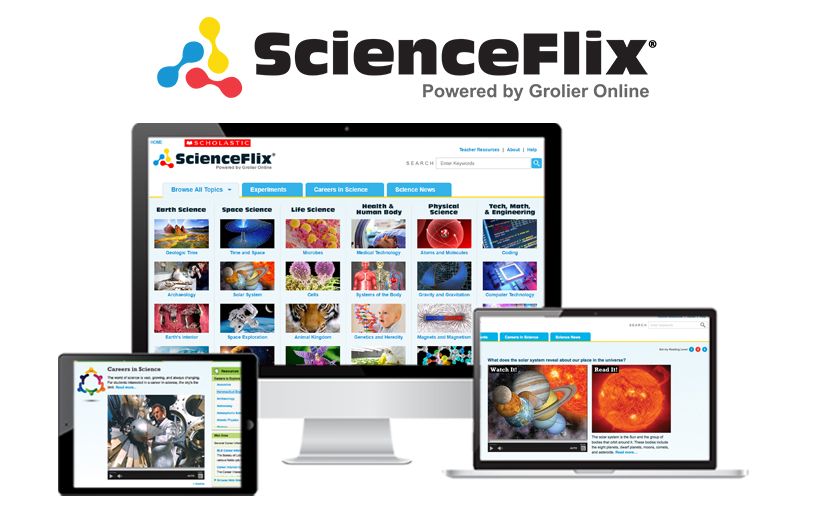
Each content unit provides a broader view of the scientific world and includes:
articles in 3 different reading levels | Spanish articles | related websites | experiments | science careers | science news